The Winter Ice Dam That Cost More Than A New Roof Would Have
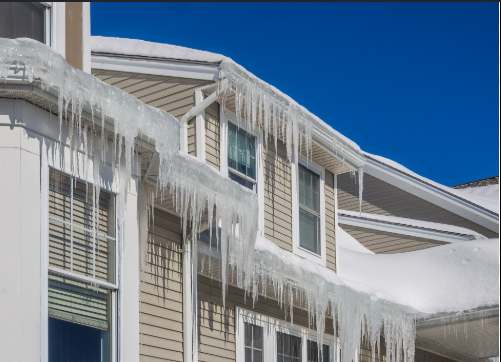
By the second week of January, the front porch of a 1970s split-level in Sandy carried a row of icicles thick enough to hide the porch light. The owner had already made the usual round of calls to the roofing companies sandy ut neighbors pass around, paid for a patch over the entry, and waited to see whether the next winter behaved. It did not. Two more months of chipping, one more spot repair and a brown ring spreading across the entry ceiling later, the arithmetic answered the question the roof had been asking for years: money spent on the ice never touched the thing making the ice, and the replacement he kept deferring would have cost less than the two winters he spent avoiding it.
The Icicle Line Above The Front Door
Icicles above a door are the visible part of a problem happening six feet behind them. Snow on the upper roof melts, the water runs down to the cold overhang, and it freezes there into a ridge of ice. Every melt cycle after that thickens the dam, and the water standing behind it has to go somewhere. On a shallow entry porch at 4,800 feet, somewhere is under the shingles and into the ceiling below.
The case we see most often on these houses is not storm damage at all. It is an ordinary roof over an attic that leaks heat, on a home where nobody has looked at the ventilation since the last time shingles went on. In a January 2026 piece on ice dams, This Old House walked through the same mechanism and said plainly that pitch and attic ventilation drive it, with shallow-pitch roofs holding interior heat and backing water up more readily than steep ones. That described this porch exactly.
See also: Office 2021 Lifetime : Cost, Features, and Lifetime Access
Warm Attic Air Made The Ice Not The Storm
Warm air rises into the attic through can lights, the attic hatch, bath fan runs and the gaps around the top plates. If it cannot escape through the ridge, it warms the deck. Snow on a warm deck melts from underneath at 20 degrees outside, which is why the dam keeps growing on clear days when nothing at all is falling. People blame the storm. The mechanism is inside the house.
Ten years ago the standard answer here was heat cable stapled along the eave and somebody with a mallet every February. It worked in the narrow sense that the icicles came down. Nothing about the assembly changed, so the cable ran up the power bill each winter and the ceiling kept staining. Today the fix is built into the roof itself, starting with a self-adhering ice and water membrane carried well past the interior wall line at the eaves, plus intake venting at the soffit that actually matches what the ridge can exhaust. Air sealing the attic floor comes first, before anything goes back on.
One rule before any of that. Nobody should climb onto a snow covered or icy roof, and nobody should stand on a ladder chipping at a dam with a hammer, because falls from height are how homeowners get seriously hurt doing this work in January. OSHA’s construction ladder standard, 1926.1053(b)(7), bars the use of a ladder on slippery surfaces until the condition is corrected or the ladder is secured, and while that rule governs work crews rather than homeowners, the physics on a residential driveway is identical. Ice removal belongs to a crew with proper fall protection.
Two Winters Of Repairs Against One Replacement
Run the numbers as an illustration, using figures in the range this work tends to land in around Salt Lake County. Say two steam removal visits the first January at $475 each, one more the following winter at $500, then $1,150 for shingle and flashing repair over the entry after the second thaw, $840 to cut out and repaint the stained ceiling, and about $300 in heat cable and the electricity to run it. That comes to $3,740 across two winters, and not one dollar of it changed the condition that made the ice.
Winter kept sending the same bill.
A full replacement on that house was quoted at roughly $15,800, with a five-year labor warranty sitting on top of the manufacturer’s coverage. The repair spending came to about 24 percent of that number and bought nothing that carried into the next season, since the roof still needed replacing at the end of it. Spending on the ice is spending on a symptom. The money only starts working when it changes the assembly, which is the whole argument for replacement over another round of patching on any roof already near the end of its service life.
The First Winter After The New Roof
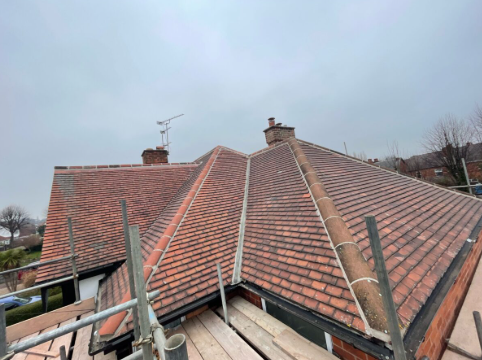
Here is how the sequence actually ran. The estimate came back inside a day, and the crew was on the house within 9 days, which is normal outside the fall rush (book in September and that gap stretches on you). Tear-off filled day one, the deck was open by noon, and two sheets of sheathing over the porch came out soft, which nobody could have known until the shingles were off. Membrane went down at the eaves and in the valleys that same afternoon, and the venting work at the soffits and ridge wrapped up on day three. By the first week of November the attic was reading within a few degrees of outside air on a cold night, which is the measurement worth asking any contractor about.
That January the porch grew a short fringe of icicles at the gutter after one heavy storm, and nothing more. No ridge of ice, no water standing behind it, no stain creeping across the entry ceiling. The point is not that ice never forms again, because on a properly cold roof it sometimes will. The point is that it has nowhere to go when it does. If you are weighing another patch against a replacement, ask the roofing companies sandy ut homeowners recommend to show you where the membrane stops on a job they finished last winter, and how much intake venting they added at the soffit. The answer tells you whether you are buying a roof or another season of chipping.